Explore our collection of insightful articles and engaging content
The night of 19 January 1990 stands as one of the darkest chapters in the history of Kashmir and of independent India. It was on this night that the Kashmiri Pandit community—an indigenous, minuscule minority of the Valley—was caught completely unprepared for a carefully orchestrated campaign of terror aimed at its physical, cultural, and civilizational erasure. What followed was not a sudden or accidental migration, but a forced exodus, the consequences of which continue to haunt the community even after more than 36 years of exile.
This blog seeks to place the tragedy in its historical context, examine the prolonged silence and inaction of successive governments, and highlight the existential crisis now confronting the Kashmiri Pandit community.
For centuries, Kashmir was known for its syncretic ethos—often referred to as Kashmiriyat—where Shaiva philosophy, Sufi traditions, Sanskrit learning, and Persian influences coexisted. Kashmiri Pandits were not merely residents of the Valley; they were aboriginal inhabitants, deeply embedded in its cultural, intellectual, and spiritual life.
The late 1980s, however, witnessed a rapid deterioration of this pluralistic fabric. Radicalization, supported by cross-border influences and religious extremism, gradually displaced the Valley’s traditional ethos. Targeted assassinations of prominent Kashmiri Pandits—government officials, scholars, social activists—created an atmosphere of fear and insecurity. These killings were deliberate and symbolic, designed to terrorize an entire community.
On the night of 19 January 1990, open threats, incendiary slogans broadcast from mosques, and a complete breakdown of law and order made it evident that the Kashmiri Pandit community faced an existential threat. Left with no effective protection from the State, families were compelled to flee overnight to save their lives, dignity, and honour.
This displacement was not voluntary. It was the direct outcome of sustained violence, intimidation, and targeted killings—amounting to ethnic cleansing and genocide. Thousands left behind ancestral homes, temples, shrines, properties, and livelihoods, carrying little more than a hope of early return. That hope remains unfulfilled to this day.
Despite this, there has been no comprehensive compensation or restitution. The material losses were never properly assessed, let alone addressed.
Being a numerically small community with negligible electoral influence, Kashmiri Pandits gradually slipped into political irrelevance. Successive governments—irrespective of ideology—offered assurances, symbolic packages, and rhetorical empathy, but failed to implement a credible, time-bound rehabilitation and resettlement policy.
Even the present dispensation, from which the community had significant expectations, has largely confined itself to incremental and insufficient measures. The core demand—secure, dignified, and sustainable rehabilitation in the Valley—remains unaddressed.
The quest for justice has repeatedly encountered institutional roadblocks. Political reluctance, administrative inertia, and judicial constraints—often citing delay, lack of witnesses, or passage of time—have denied the community its rightful legal redress. Crimes of targeted killings and mass displacement have gone largely unpunished, reinforcing a sense of abandonment and injustice.
Exile has dispersed Kashmiri Pandits across different regions of India and abroad. This forced dispersal has weakened traditional social structures, diluted collective cultural life, and created a deep sense of social disconnect. Community cohesion, once nurtured through shared geography and institutions, now struggles against fragmentation and assimilation pressures.
The present generation of elders represents the last cohort born and raised in Kashmir. Over the past 36 years, nearly three generations have passed away in exile, many with the unfulfilled desire of returning to their homeland. Younger generations, born outside the Valley, naturally lack the lived experience and emotional attachment to Kashmir, posing a serious challenge to cultural continuity.
Language, rituals, festivals, and oral traditions—once sustained by daily life in the Valley—are now at risk of gradual extinction.
Today, the Kashmiri Pandit community stands at the brink of a demographic and cultural crisis. Prolonged displacement, lack of justice, cultural dilution, and declining numbers have created a real and pressing threat of extinction. This is not merely the loss of a community, but the erasure of an ancient civilizational strand of Kashmir.
The tragedy of Kashmiri Pandits is not only a community issue; it is a matter of national conscience. Justice delayed for over three decades cannot be postponed indefinitely. What is urgently required is:
As we mark another year of exile on 19 January, the question remains stark and unavoidable: How long must a displaced indigenous community wait for justice?
History will judge not only those who committed these crimes, but also those who chose silence in the face of suffering.
by Author: Suniel Kumar Dhar • 5
by Author: Mithlesh Dhar • 5
by Author: Romil Dhar • 5
Dear Respected Elders, Thinkers, and Fellow Members of Our Dispersed Kashmiri Community,
Namaskar to all!
Today, I write not as an individual, but as a humble voice from the collective heart of a community that once glowed with the light of knowledge, tolerance, art, and spiritual grace — and now stands painfully scattered, divided by egos, party lines, and self-interests.
It hurts deeply to see that we, the inheritors of one of the world’s oldest and richest civilizations, are drifting farther from each other every passing day. We debate, we criticize, we question — but seldom do we unite. Our temples, our homes, our language, our very sense of belonging — all stand at a fragile edge, waiting for our conscience to awaken.
Are we waiting for a moment when there will be none left to carry the name, the songs, the memories, the sacred traditions of Kashmir Shaivism, Rishi-Sufi harmony, and Sanskrit learning that once defined our existence?
Time is slipping away. Generations are growing without roots. We cannot afford to allow our internal divisions — our self-ego, our pride in titles, posts, or petty recognitions — to bury the greater cause of our collective survival.
Let us, therefore, rise above our differences and create one unified social, cultural, and political authority — a single umbrella under which every Kashmiri soul, displaced or non-displaced, can find belonging, purpose, and strength.
Let it be a Mahasabha of minds and hearts, not of egos — where decisions are guided by wisdom, compassion, and a shared dream of rebirth.
We owe it to our ancestors who preserved this civilization for thousands of years.
We owe it to our children who look up to us for direction.
And we owe it to the sacred soil of Kashmir, which still whispers —
“Come together, my children, before my stories turn silent.”
Let this appeal be the spark — for unity, for awakening, for rebuilding our lost confidence and dignity as a people.
Let us form a vibrant, forward-looking, and compassionate authority that safeguards our heritage, addresses our long-pending issues — political, economic, and social — and revives our collective identity.
The time to act is now, not tomorrow.
Let us silence our egos, open our hearts, and listen to that divine inner voice that has always guided our people through centuries of struggle and survival.
Together we stand — divided, we vanish.
May our conscience guide us towards unity, revival, and strength.
Orzoo te Dorkoth.
With folded hands and deep concern
by Author: Yekjah • 5
by Author: Mithlesh Dhar • 5
by Author: Romil Dhar • 5
Amar Mahal Palace stands as one of the most remarkable testimonies of royal heritage in Jammu, in the Indian Union Territory of Jammu and Kashmir. Perched majestically on a hill overlooking the River Tawi, this imposing palace-cum-museum marries the grandeur of Dogra royal history with European architectural influences. Today, the palace is a cherished cultural landmark, offering visitors a rare glimpse into the royal lifestyle, art collections, rare manuscripts, and artistic treasures of India.
Amar Mahal Palace was commissioned by Raja Amar Singh, a prominent ruler of the Dogra dynasty in the 19th century. A French architect was entrusted with its design, resulting in a structure inspired by a French château — a style highly unusual for the region at that time. Built largely with red sandstone and red bricks, the palace reflects European elegance blended with local craftsmanship.
During its construction, Amar Mahal stood as the tallest and most imposing building in Jammu, symbolizing power, prestige, and the cosmopolitan sensibilities of the Dogra rulers.
Originally a royal residence, the palace later became closely associated with Maharani Tara Devi (wife of Maharaja Hari Singh), who lived here, and whose private quarters are now preserved as part of the museum experience.
In 1975, the palace was meticulously converted into a museum and inaugurated by then Prime Minister Indira Gandhi. The transformation was part of a larger vision to preserve Indian art and heritage for public appreciation. The palace was donated to the Hari-Tara Charitable Trust by Dr. Karan Singh, scion of the Dogra royal family, to ensure the conservation and promotion of its cultural treasures.
Today, Amar Mahal Museum stands not merely as a relic of royalty but as a cultural hub — hosting exhibitions, heritage walks, workshops, scholarly lectures, and guided tours that educate visitors about Dogra history, art, and traditions.
At first glance, Amar Mahal overwhelms visitors with its European castle-like silhouette, red sandstone façade, and classic symmetry. The palace’s design incorporates several distinct architectural elements:
The setting on a hillock overlooking the Tawi River not only provides spectacular views but also situates the palace as a landmark visible from many parts of Jammu city.
Amar Mahal Museum houses a rich and diverse array of exhibits, ranging from lavish royal artifacts to classical Indian paintings:
The museum’s most iconic exhibit is the golden throne of the Dogra rulers, reportedly weighing 120 kilograms and decorated with lion figures at its corners. This extravagant throne reflects the might and opulence of the Dogra monarchy. The throne is securely displayed behind glass in a dedicated hexagonal chamber due to its immense value and historical significance.
Art lovers will find rare collections of miniature paintings from the Pahari and Kangra schools — styles known for their detailed narratives and vibrant colors. Among the most notable sets are the 47 pieces depicting the legendary tale of Nala and Damayanti, based on the Mahabharata.
The museum also displays works by renowned modern Indian artists including M.F. Hussain, Laxman Pai, G.R. Santosh, J. Swaminathan, Bikash Bhattacharjee, and Ram Kumar — making it a unique blend of traditional and modern art.
The Durbar Hall at the entrance gallery shows portraits of the Dogra royal family, capturing historical figures and pivotal moments.
On the upper floors, the museum preserves a library of over 25,000 rare books covering philosophy, religion, political science, fiction, and more — making it a treasure trove for researchers and literature enthusiasts alike.
One of the most cherished sections is the preserved living quarters of Maharani Tara Devi, showcasing her silver bedspread, period furniture, photographs, personal clothing, and even her Victorian-style bathroom and the Crown of India decoration presented to her in 1945.
These galleries collectively provide a holistic narrative of Dogra history, from royal dignity and ceremonial regalia to artistic achievements and cultural transitions.
Amar Mahal Palace Museum is one of the top cultural attractions in Jammu, and planning ahead can help make the visit memorable:
(Note: fees and timings can vary slightly based on local policies — it’s best to check current rates).
Beyond the bricks and galleries, Amar Mahal Palace embodies the confluence of Dogra history and Indian art heritage. It preserves centuries of cultural evolution and showcases how royal patronage contributed to art, literature, and cultural discourse in northern India. For visitors, the palace offers more than sightseeing — it is a journey through time, from the age of regal splendor to India’s modern cultural renaissance.
Amar Mahal is centrally located near other landmarks worth exploring, such as:
Amar Mahal Palace is not just a museum; it’s a living archive of Dogra heritage, Indian artistry, and architectural fusion. From its 120 kg golden throne to 25,000 rare books, from Pahari miniatures to contemporary paintings, it remains a must-visit destination for historians, artists, and travelers alike. Whether you’re exploring the roots of Jammu’s regal past or simply immersing in exquisite craftsmanship, Amar Mahal stands as an enduring symbol of India’s cultural richness.
by Author: Yekjah • 5
by Author: Suniel Kumar Dhar • 5
by Author: Romil Dhar • 5
The holy Amarnath Cave, situated in Jammu & Kashmir, is a revered pilgrimage site for Hindus. Located at an altitude of 3,888 metres (12,756 feet) above sea level, the cave is nestled in the Himalayan Mountains of Kashmir, and is dedicated to Lord Shiva. Every year, lakhs of devotees undertake a spiritual journey here to witness the naturally formed ice Shiva Lingam — a symbol of divine presence and eternal faith.
The Amarnath Cave has been a sacred site for centuries with its history dating back to ancient times. As per Hindu mythology, this is the cave where Lord Shiva shared the secret of creation and eternity, known as the Amar Katha, with his Consort Parvati. To ensure privacy, lord Shiva left behind his companions and elements along the main and ancient route — from Nandi at Chandanwari and Sheshnag at Sheshnag lake, to the five elements at Panchtarni. It is also said that two pigeons overheard the divine secret and became immortal. Some pilgrims even report sightings of these birds near the cave, adding mystique to the journey. The main attraction of the Amarnath Cave is the naturally formed ice Shiva Lingam, which is believed to wax and wane with the phases of the moon. The ice Lingam is considered a manifestation of Lord Shiva and is worshipped by devotees during the annual pilgrimage.
The holy stream that flows down from the foothills of the Amarnath cave is called the Amaravati. It originates from the melting of ice and snow near the sacred Amarnath cave shrine in the Himalayas of Kashmir. Pilgrims on the traditional Pahalgam route usually take a holy dip at Panjtarni, a beautiful meadow and confluence of five streams, or at Amaravati stream near the cave itself, to purify themselves before having darshan of the holy ice lingam of Amarnath ji. In local usage, this stream eventually joins the Lidder river near Pahalgam. The entire water system is considered extremely sacred by devotees, as it carries the melted waters from around the holy cave.
Historical references to the cave go as far back as the 11th century, with Kalhana’s Rajatarangini describing it as Amareshwara. Local legends also speak of a Muslim shepherd, Buta Malik, who discovered the cave. Since then, his descendants have been closely associated with the shrine's tradition.
The pilgrimage is especially significant during the month of Shravan (July–August), when the Shiva Lingam reaches its peak formation. The yatra begins in June/July and concludes on Shravan Purnima, aligning with Raksha Bandhan — a day of spiritual and cultural importance. Devotees chant “Har Har Mahadev” and “Bum Bum Bhole” as they make their way through high-altitude terrains, often observing fasts and reciting sacred mantras along the way.
Two main trekking routes lead to the cave, the traditional and ancient 46 km route from Pahalgam and the shorter, steeper 14 km route from Baltal. The yatra is managed by the Shri Amarnathji Shrine Board (SASB), with support from the Indian Army, CRPF, local police, and volunteers. Pilgrims are provided with medical aid, free meals (langars), tents, ponies, and other facilities. Due to the challenging terrain, health certificates and registration are mandatory.
Beyond religion, the yatra holds deep cultural value. It generates seasonal employment for thousands and is also a symbol of communal harmony, with many local Muslims actively involved in supporting the pilgrims. The spirit of unity and service truly defines the essence of this sacred journey.
The Amarnath Yatra is more than a pilgrimage — it's a test of devotion, endurance, and inner faith. Amid snow-capped peaks and echoing chants, the journey becomes a once-in-a-lifetime experience that connects the mortal to the divine.
हर हर महादेव
by Author: Yekjah • 5
by Author: Suniel Kumar Dhar • 5
by Author: Mithlesh Dhar • 5
Some places don’t just welcome you — they silence you.
The Ancient Sun Temple of Mattan in Kashmir was one such place for me.
This was my first visit to Mattan, and the moment I stood before the ruins of the ancient Sun Temple, I felt a strange stillness settle in. Surrounded by massive stone walls weathered by centuries, I realized I wasn’t just visiting a monument — I was standing inside history itself.
The Sun Temple of Mattan, also known as Surya Mandir, dates back to ancient times and is believed to have been an important center of sun worship in Kashmir. Though now in ruins, the structure still holds an undeniable power. The stone blocks, perfectly aligned and imposing, speak of an era when architecture was guided as much by astronomy and devotion as by engineering.
As seen in the image from my visit, the sunlight pierced directly through the temple structure, flooding the ancient stones with a golden glow. It felt symbolic — as if the Sun God still visits this temple every day, just as He did centuries ago.
Standing there for the first time, I was completely mesmerized. The scale of the temple surprised me — massive, resilient, and dignified even in decay. People around me instinctively folded their hands in prayer, facing the temple with quiet reverence. No one needed to be told to be silent; the place commanded respect on its own.
The open courtyard, scattered stone remains, and the cold Kashmiri air added to the experience. It felt spiritual without being forced — ancient without feeling dead.
What makes Mattan’s Sun Temple special is not just its history, but its setting. The temple sits amidst open land, mountains in the distance, and a sky that feels unusually close. The grass beneath my feet, the ancient stones beside me, and the bright sun above created a perfect harmony between nature and faith.
Even though much of the original structure has crumbled, the soul of the temple remains intact. You don’t need a guide or plaques to feel its importance — you feel it instinctively.
As I walked away from the temple, I kept looking back. Some places imprint themselves on your mind, and the Sun Temple of Mattan did exactly that for me. It wasn’t loud or dramatic - it was quiet, powerful, and deeply moving.
For anyone traveling through Kashmir, especially those who appreciate ancient history, spirituality, and architecture, this temple is a must-visit. It is not just a destination; it is an experience - one that lingers long after you leave.
My first visit to the Ancient Sun Temple of Mattan was unforgettable. And I know, without doubt, that this won’t be my last.
Notes: Currently, the Ancient Sun Temple is under Archealogical Survey of India (ASI) and is a heritage place that is preserved. Usually, travel packages to Kashmir don't include a visit to this site. If you would like to visit, you will have to book your own cab. We had a taxi per day that used to be with us for the whole day. If you need more details about the same, you can contactme on my WhatsApp: +919130011968
by Author: Yekjah • 5
by Author: Suniel Kumar Dhar • 5
by Author: Mithlesh Dhar • 5
.
A couple of months back, a friend forwarded on WhatsApp, a message from the Vijayeshwar Panchang office (Jammu), asking people to share details of their Gotra, Kul Devi, and Bhairava to which their family (Parivar) was attached to, in a Google Survey Form. Considering the current concerns about ‘fake’ messages, I first cross checked with Pt Omkar Nath Ji, the editor/ owner of Vijeyeshwar Panchang Karyalaya and he very kindly confirmed that his group is indeed conducting a survey amongst Kashmiri Pandit Community across the globe to compile and tabulate data. A very welcome step, indeed that shall help in documenting and compiling community details.
With this idea, I started looking for details – I knew my Gotra and Kul Devi but was uncertain about the Bhairava of our Kul(family). My uncle, Sh TK Munshi being the senior most in our Kul, confirmed that our Kul Bhairava is Poornaraz Bhairava, located in what traditionally was known as Khoshal Sar area (on Zadibal link road). Appears, my uncle’s father, late Dr Shambhu Nath Ji Munshi used to oversee the functioning/ maintenance of Poornaraz Bhairava Asthapan in the Khoshal Sar area for many years! He also mentioned that Dr Shambhu Nath ji would travel by boat to reach the Poornraz Bhairava Asthapan, and on his way back, would occasionally buy Nadru from the area! As I started doing research on the topic, I found some confusion about the location of these Asthapans. Several writers have written about the concept of Bhairava, the spiritual symbolism involved, their importance in Tantra but unfortunately, there was no clarity or concurrence about their location in Srinagar. After much deliberation and consultations, I have arrived at the following conclusion:
Locations of Ashta Bhairavas of Srinagar are:
Other important Bhairava locations in Kashmir:
Every part of Kashmir Valley has its own Bhairav with well-defined zones of influence. Thus, we find Bhairav Asthapans in different villages of Kashmir!
Historical Background:
The concept of ‘Bhairavas’ in Kashmir is said to have emerged during the rule of King Praversen II in sixth century; the king desired to build a new city. He was residing in the city built by his grandfather, King Purandhara, which was prone to floods, fire, and epidemics. King Praversen II is said to have prayed to his Isht Dev, Vetalraj Bhairava for help and guidance. With His blessings, the king laid the foundation of the new city and divided the city of Srinagar into eight zones, presided over by their respective Bhairvas. Temples were constructed in their names. It is interesting to note that all the Asht Bhairavas were located around the Hari Parbat hillock. Bhairavas have usually chosen trees as their dwelling places; in Kashmir, Mulberry (Tul in Kashmiri) or Chinar trees are often seen at Bhairava Temples.
These Bhairavas are regarded as the protectors of their respective areas. The influence of Bhairavas continues to prevail in religious, cultural, and folk tales of Kashmiri Pandit community. Bhairav is one of the deities worshipped during Shivratri Pooja in Kashmir - the festival is also celebrated as Bhairavutsav. Whenever any Puja is offered in Kashmiri Pandit families (Preypyun), Naivedya is first offered to the Ishta Devata and the Ishta
Bhairava, the guardian deity of the area. The devotees offer Naivedya to their "Iha- Rashtradipatis", (as found in the Kashmiri Naivedya Mantra Preypyun), to Bhairavas and Yoginis with a handful of yellow rice, known as Taher in Kashmiri or any other offering.
Taken from the Preypyun Mantas as mentioned in Vijayehwar Panchang:
भवान्यैक्षेमंकर्यैभगवत्यैवैखरी भगवत्यैववतस्ता भगवत्यैगंगा भगवत्यैर्यमुनाभगवत्यैविद्धलक्ष्म्यै
महालक्ष्मर्यैमहाविपुरिुन्दर्यैिहस्त्रनामन्यैदेव्यैभवान्यैअभर्यंकर्यैदेव्यैभवान्यैक्षेमंकर्यैभगवत्यै
िवव शिुघावतन्यै इहराष्ट्रा-विपतर्ये आनन्देश्वर
( विि भैख िे आप कु ल का िम्बंि है उिका नाम लें)
भैरवार्य इंद्रार्य वज्रहस्तार्य अग्नर्येशक्तिहस्तार्य र्यमार्य दण्डहस्तार्य नैऋतर्ये.
र्या कावित्र्योवगनी रौद्रा िौया घोरतरा परा । खेिरी भूिरी रामा तुष्ट्ा भवंतुमेिदा ।
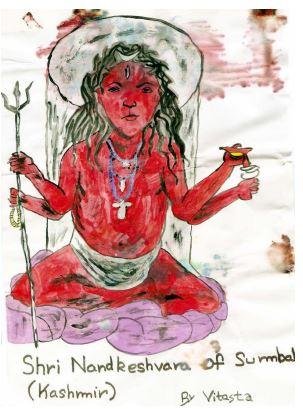
This painting of Nandkeshwar Bhairava was drawn by Ms Vitasta, granddaughter of Dr CL Raina.
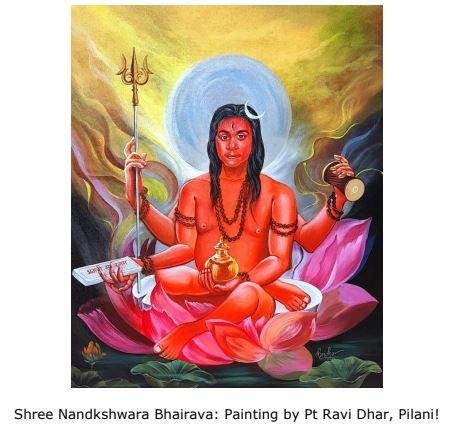
The Nandkeshwara Bhairava at Sumbal, Distt Ganderbal, is considered the most powerful Bhairava of Kashmir by some knowledgeable people, adept in the Trik School of Kashmir Shaivism. As per Mr Ashok Sapru, son of late Pt B.B. Sapru, the noted headmaster of CMS School, Srinagar, during his school days, their family would travel to Tulmul (Kheer Bhawani) by Doonga from Saperyar (Habba Kadal) to Shadipore over River Vitasta and, while returning, pay obeisance to Nandkeshwara Bhairava at Sumbal.
BHAIRAVAS
In Sanatan tradition, Bhairavas are said to be attendants of Lord Shiva and are known as Shivaganas or Bhutaganas. In the Bhairava Tantra, Bhairava represents combination of three aspects of Lord Shiva; ‘Bha’ from Bharena, i.e., maintenance of the universe. ’ra’ from revana i.e., withdrawal of universe and ‘va’ from Vatmana i.e., letting go of universe. Thus, Bhairava represents three aspects of Shiva; Srshti-—manifestation, Stehti--- maintenance and Samhara ---withdrawal. The concept of Kashmiri word Bhairava has its deep roots in the Trika philosophy---Agama Shastras, Pratyabijnya Shastra and the Spanda Shastra. Bhairava is the explanation of the term Shiva, who is the ultimate Reality of this intrinsic world and transcendental understanding/reality. The Bhairav Stotra composed by Acharya Abhinavagupta reveals the foundation of the Shiva Darshan. Bhairavas and Yoginis are associated with Tantric religious practices in Sanatan.
Ashta Bhairavas (Eight Bhairavas) are eight manifestations of Kaal Bhairava, a ferocious aspect of Lord Shiva, who is considered the supreme ruler of time of the universe and the chief form of Bhairava. They guard and control the eight directions. The eight Bhairavas represent eight different elements in which five elements represented by Bhairava are sky, air, fire, water and earth and the other three beings are sun, moon, and Atma (the soul). Each of the eight Bhairavas are different in appearance, have different weapons, have different vahanas and they bless their devotees with eight types of wealth representing Ashta Lakshmis. We find temples dedicated to Kaal Bhairav in several cities of India but most famous are the temples at Ujjain and Varanasi (Kashi) – in fact, Kaal Bhairav is considered the Kotwal(administrator) of Kashi and the deity is taken out in a proper procession for ‘inspection’ of the city once a year!
In Kashmiri ‘Trik’ tradition, it is believed that Shiva Sutras were revealed by Lord Shiva, in the form of Svachanada Bhaiarva through his five faces. Svachanada in common parlance means Svatantra or the free will which is the keynote of Kashmir Shaivism. Vasugupta founded the school of Trika philosophy. Later Kallata and Sommananda wrote explanatory notes on its aspects and developed a philosophical treatise on the same. The Trika and Shaivism in Kashmir are based on Tantras which have been classified as Bhairava, Rudra and Shiva. There are four schools of Shivaite philosophy; Pratyabhigna,
Karma, Kulla and Spanda. Shiva’s most significant aspect is as a guardian of directions. In his eightfold manifestations of Asta Bhairavas, Bhairava presides either alone or paired as consort with eight Mother Goddesses, over the spatio-ritual organization of sacred cities. In Kashmir Shaivism, Bhairava Tantras are sixty-four in number. The scriptures of Bhairava Shastras are sixty-four in number. The total number of Bhairavas is sixty-four as are the Yoginis.
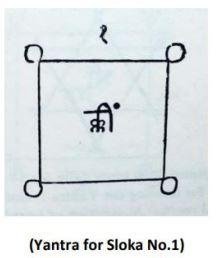
Much of what constitutes Sanatan Dharma, including its streams like Vedanta, Shiv Shastras, Kashmir’s Trik Shaivism, Shakti worship etc are full of symbolism and Tantra! Adi Shankar composed ‘Saundarya Lahiri’ in Kashmir which is a treatise full of symbols and tantra practices – every shloka has a yantra (graphic diagram). He also found his course correction in Kashmir by discovering the concept of Shakti:
वशवः शक्त्या र्युिो र्यवद भववत शिः प्रभववतुं
न िेदेवं देवो न खलुकु शलः स्पक्तन्दतुमवप ।
Literal Meaning:
"Shiva becomes capable of creating the Universe, only when united with Shakti. Otherwise, He is incapable of even stirring without Shakti.
Acharya Abhinavgupta, in his Bhairav Stotram addresses Lord Shiva as Bhairav Nath:
ॐ व्याप्त - िरािर - भाव – ववशेषं, विनमर्यम् एकम् अनंतम् अनावदम्
भैर-व-नाथम्-अनाथ-शरण्यम्, तनमर्य - वित्ततर्या - हृवद - वन्दे।
Loosely translated: I(Abhinavagupta), with one pointed devotion, am praying to that the supreme all-pervading Lord Śiva, who is himself present in each and everything that exists, and who through realization reveals himself as the one limitless Bhairavanātha the protector of the helpless.
This information has been culled from material compiled by Sh CL Gaddoo, Delhi, writings of Mr Sunil Rajanak(current editor, Naad), my discussions over phone/ email with Mr CL Raina (ex-Kashmir University, Deptt of Iqbal Studies, currently in USA). I am highly grateful to my friend Sh Suneil Dhar, originally from ‘Khanka hi Sokhta’ area (Mata Roop Bhawani original Janmasthan), for sharing his experience of having participated in the upkeep of Poorna Raz Bhairava Asthapan till the ‘friendly neighbourhood Muslims’ burned down the place again in 1980s. I also recall my discussions with late Sh Ashok Kaul( originally Naidyar, Rainawari, who spent his entire life in Ottawa, Canada -he had drawn up a map depicting the location of the Asht Bhairavas of Srinagar.
I realize that I am not qualified to comment about the highly complex issues like Yoginis and Bhairavas. These are matters deeply spiritual and symbolic. I invite the attention of learned persons who can shed information about these concepts. My only contribution might be trying to finalize location of the Asht Bhairava Asthapans in Srinagar – so that posterity knows!
by Author: Yekjah • 5
by Author: Suniel Kumar Dhar • 5
by Author: Mithlesh Dhar • 5
On June 3, 2025, the birth anniversary of Mata Kheer Bhawani (also known as Ragyana Devi), located in Tulmul village of Kashmir, was celebrated. This festival is celebrated on the Ashtami of Jyeshtha Shukla Paksha, which is extremely important for the Kashmiri Hindu community.
History of Mata Ragyana (Kheer Bhawani) and arrival in Tulmul Mata Ragyana, also known as Kheer Bhawani, is considered the Kuldevi of Kashmiri Pandits. Lord Hanuman is said to have brought her in the form of water in his kamandal and established her in Tulmul. Tulmul's name is derived from the Sanskrit word 'atulya mulya', which means 'unique value'. The place is located about 25 kilometers northeast of Srinagar.
The temple was built and rebuilt by the Maharajas of Jammu and Kashmir, including Maharaja Ranbir Singh, Maharaja Pratap Singh, and Maharaja Hari Singh. A heptagonal holy pond is situated in the temple premises, whose water changes into different colours, which is considered to be an indication of the goddess's emotions and future events.
🎉 Kheer Bhawani Mela: A symbol of faith of Kashmiri Pandits
Kheer Bhawani Mela, the biggest religious festival of Kashmiri Pandits, is celebrated every year on the Ashtami of Jyeshtha month. On this day, thousands of devotees gather at the Kheer Bhawani temple located at Tulmul.
Features of the festival:
Colour change in holy water: The water of the pond changes into various colours, such as red, pink, orange, green, blue, and white. Black coloured water is considered inauspicious.
Kashmiri cuisine: Kashmiri cuisine holds special significance in the fair. Devotees offer kheer (made of rice and milk) to the goddess. Apart from this, traditional dishes like dum aloo and kahwa (Kashmiri tea) are also served.
Community Unity: The festival is a symbol of Hindu-Muslim unity. The local Muslim community sets up shops selling flowers and other offerings to the devotees and serves them.
Religious Rituals: Devotees offer prayers at the temple, perform havan, and seek blessings from the goddess.
Faith and Struggle of Kashmiri Pandits
Kheer Bhawani Mela is a symbol of the faith and struggle of Kashmiri Pandits. Kashmiri Pandits were displaced from the valley in the 1990s, but despite this, they return every year to participate in this fair. It shows their deep attachment and faith in their motherland.
This year, the Kheer Bhawani Mela to be held on June 3 will present a live example of the faith, culture, and traditions of Kashmiri Pandits. This festival not only holds religious significance, but it also symbolizes the cultural heritage and community unity of Kashmir.
Note: This article was originally shared on WhatsApp by unknown author.
by Author: Yekjah • 5
by Author: Suniel Kumar Dhar • 5
by Author: Mithlesh Dhar • 5
Watak Masala is a sacred Shivratri (Herath) Pooja Samagri set traditionally used by Kashmiri Pandit families during the holy festival of Herath, the Kashmiri celebration of Maha Shivratri. Despite the word “masala,” it is not a cooking ingredient but a ritual collection of essential pooja items required to perform the Watak Pooja with devotion and correctness.
For those living away from Kashmir, finding authentic Watak Masala online has become essential to keep traditions alive.
Watak Masala is a carefully assembled set of ritual items used specifically for Watak Pooja, a central ritual performed during Shivratri in Kashmiri Hindu households.
The word Watak refers to the earthen pot that symbolizes Lord Shiva and Goddess Parvati, while Masala in this context means a complete collection of sacred items, not spices.
Herath is not a single-day event but a multi-day spiritual observance. Watak Masala plays a vital role because:
Using a complete Watak Masala ensures the pooja is performed without omissions, which is spiritually important in Kashmiri customs.
A traditional Watak Masala set includes the following 25 sacred items, each with ritual importance:
Many Kashmiri Pandit families now live across India and abroad. Buying Watak Masala online helps because:
Before buying Watak Masala online, ensure that:
Authenticity matters more than appearance.
Each item from the Watak Masala is used at a specific stage of the pooja.
Many people search:
All of these refer to the same sacred pooja kit, not food or spices. Clarifying this helps buyers make the right decision.
Watak Masala is not just a product; it is a cultural responsibility. Using the correct samagri ensures:
If you are preparing for Shivratri and want to perform Watak Pooja the traditional Kashmiri way, choosing the right Watak Masala is essential. A complete and authentic set allows you to focus on devotion rather than last-minute arrangements.
Celebrate Herath with faith, tradition, and completeness.
You can buy Watak Masala from our marketplace: Yekjah Marketplace
by Author: Yekjah • 5
by Author: Suniel Kumar Dhar • 5
by Author: Mithlesh Dhar • 5
Comments (0)